What Are the Best Homemade Ice Melt Alternatives to Salt? Quick Answer
Homemade winter treatments do not all work the same way. Salt and salt-based brines chemically melt ice by lowering water’s freezing point. Alcohol-water mixtures can also lower freezing temperature, but their performance depends on concentration and they should not automatically be considered pet-safe. Sand, ash, and similar materials primarily provide traction rather than melting ice. Beet and pickle brines usually still contain salt, while fertilizer, vinegar, sugar, and other household remedies have important performance, pet, surface, or environmental limitations.
Key Takeaways About Homemade Ice Melt
Not every homemade winter treatment actually melts ice.
Salt and brine melt ice through freezing-point depression.
The current CDC citation does not support a -20°F freezing point for rubbing alcohol; CDC lists pure isopropyl alcohol at approximately -127°F. (CDC)
Household alcohol/water mixtures have concentration-dependent freezing behavior.
Isopropyl alcohol should not be described as automatically pet-safe; ingestion can cause poisoning. (Pet Poison Helpline)
Beet brine and pickle brine generally still contain sodium chloride.
Fertilizer containing urea can contribute nitrogen and ammonia to runoff.
Sand, grit, ash, and similar materials mainly improve traction rather than chemically melting ice.
CMA is a non-chloride deicer, but its environmental and temperature performance still have limitations.
For areas used by pets, evaluate the actual ingredients and prevent paw residue from being ingested through grooming. (ASPCA)
FHWA and EPA distinguish chemical deicers from abrasives such as sand, which primarily increase traction. EPA also describes beet-derived materials as additives commonly used with salt or brine rather than universally salt-free replacements. (EPA Nepis)
Listen to the Article: Audio Version Available
To prevent accidents due to slippery driveways, sidewalks during snowy winters, one needs to be prepared for a solution beforehand. Either you can go for some ice melt readily available in the market or use salt instead. Nevertheless, there can be an instance when you run out of both rock salt as well as ice melt stock, and to tide over such a crisis, here we list out some of the best alternatives to salt which will serve as an ice melt.But first, let’s talk about some important topics that every homeowner must know. Ready? Let’s get into this.
Homemade Ice Control: Deicers vs Traction Methods
Chemical deicers
These lower the freezing point of water and can weaken the bond between ice and pavement.
Examples:
Sodium chloride brine
Some alcohol/water mixtures
Purpose-designed deicing chemicals
Salt-containing alternatives
These may reduce the amount of conventional rock salt used but are not salt-free.
Examples:
Beet + salt brine
Pickle brine
Traction materials
These primarily make an icy surface less slippery.
Examples:
Sand
Grit
Ash
Ice Traction
Walk On Ice
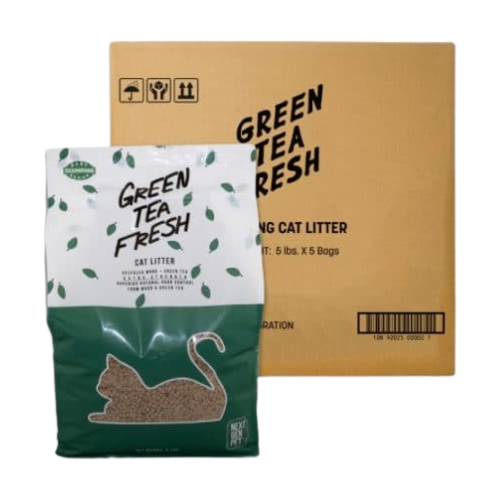
Poison Control specifically classifies sand, gravel, kitty litter, and wood ash as products intended for traction instead of ice melting. (Poison Control)
Limited household methods
Vinegar
Sugar solutions
Fertilizer
These should be described as experimental or limited-use approaches rather than recommended equivalents to purpose-designed deicers.
Safe Paw is the flagship product of Gaia Enterprises Inc., founded by Steve Greenwald, a chemical engineer. For over 30 years, Gaia Enterprises has specialized in pet-safe, environmentally friendly winter safety products, including Safe Paw, Walk On Ice, and Safe Thaw.
Pet Safe Ice Melt Safety and Snowfall: What Every Homeowner Must Know
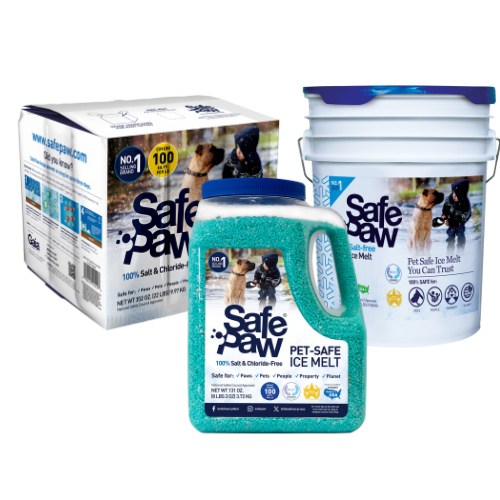
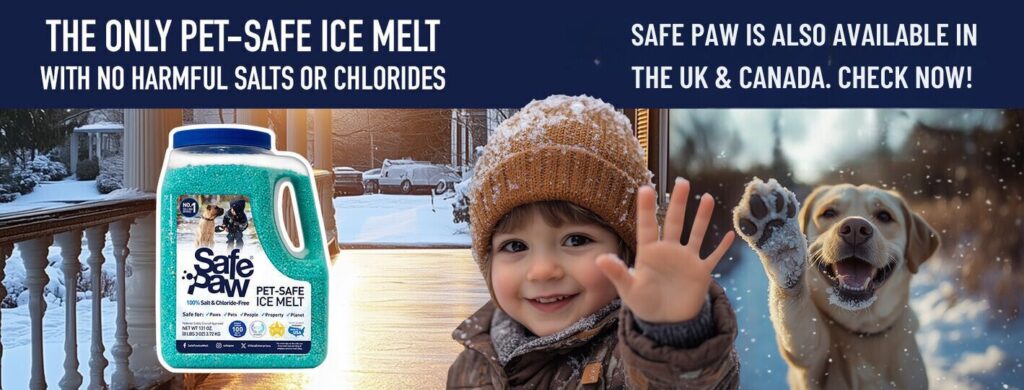
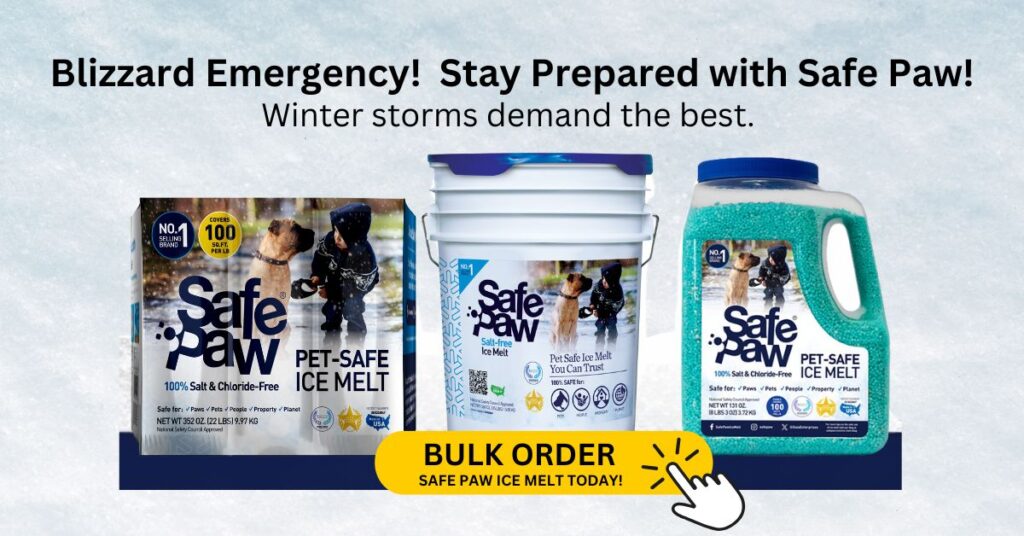
Safe Paw is 100% salt-free and chloride-free, making it safe for pets, kids, and the environment (Gaia Enterprises).
How to Use Pet Safe Ice Melt on Concrete and Driveways Without Damage
When you’re using an ice melt to get rid of the snow/ice from your driveway most of the time you’re dealing with harmful chemicals. Therefore, it’s imperative to understand the correct usage of ice melt products. It becomes even more important if you have pets at home or if you’re a new homeowner and don’t want your property to suffer long-term irreversible damages. Speaking of which, ice melt for driveways, sidewalks, and other concrete surfaces should not contain chlorides in any form. Salt is a big no-no. If your concrete is younger than 12 months do not use any ice melt products on it. Always follow the manufacturer’s instructions for application rates to avoid overuse, which can lead to environmental and structural issues.
Top Homemade Pet Safe Ice Melt Recipes to Replace Rock Salt
1. Rubbing Alcohol as a Limited DIY Ice-Melting Solution
How it works / Recipe
Isopropyl alcohol mixes readily with water and can lower the freezing point of an alcohol-water solution. However, the freezing point depends on the actual alcohol concentration. The CDC/NIOSH source cited on this page lists pure isopropyl alcohol at approximately -127°F (-88°C), not -20°F. Therefore, -20°F should not be presented as a universal freezing point for household rubbing alcohol or for the diluted DIY recipe below. (CDC)
Pet limitation: Isopropyl alcohol should not be classified as pet-safe. Ingestion can cause symptoms including gastrointestinal upset, low blood sugar, low blood pressure, slowed heart rate, acid-base disturbances, intoxication-like neurological effects, and breathing difficulty. (Pet Poison Helpline)
⚠️ Note: This is a temporary fix and works best for small patches, not large driveways.
Ice and Snow Everywhere? Stock Up on Safe Paw – the ONLY Pet Safe Ice Melt you can trust
2. Vinegar and Water: A Limited Mild-Weather DIY Option
This DIY is workable and easy to prepare.
How it works / Recipe
Vinegar contains acetic acid and can modestly change the freezing behavior of water, but household vinegar is not a high-performance pavement deicer. It should not be presented as equivalent to conventional deicing chemicals.
ASPCA also notes that diluted vinegar can cause stomach upset or irritation following pet exposure, so “pet-safe” should be qualified rather than absolute. (ASPCA)
DIY Recipe: Mix 1 part water with 3 parts vinegar in a spray bottle. Apply directly to icy spots.
⚠️ Warning: Vinegar is acidic and, with repeated or concentrated use, can etch concrete surfaces — particularly decorative or sealed concrete.US EPA
3. Why Fertilizer Is Not Recommended as a Routine DIY Ice Melt
Some fertilizer ingredients such as urea can depress freezing temperature, but fertilizer is not recommended as a routine residential deicer. Urea runoff can contribute ammonia and nitrogen to soil and surface water, while fertilizer ingredients can also create pet-exposure concerns.
EPA documents urea and ammonia contamination in surface water, groundwater, and soils associated with pavement-deicing applications. (US EPA)
ASPCA also advises keeping pets away from fertilizers because ingestion can cause gastrointestinal and other effects. (ASPCA)
Warnings / Limitations
Vegetation damage risk: runoff can harm lawns/plants.
Concrete damage: chemical reactions may cause staining or surface issues.
Less effective at colder temps.
Eco Friendly Ice Melt
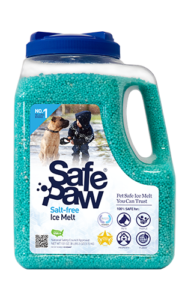
Pet Safe Ice Melt – Safe Paw
The Original and the #1 Pet and Child Safe Ice Melt for over 20 years. Guaranteed environmentally safe – will not harm waterways and sensitive wetlands.
4. Beet-Brine Treatments: Salt-Reduction Additive, Not Salt-Free Ice Melt
Beet-derived winter treatments are often mixed with salt or brine. They can improve adhesion and help reduce how much salt is lost from the road, but a beet-brine mixture remains chloride-based when sodium chloride is part of the formula.
EPA specifically describes beet juice, molasses, and similar materials as additives to salt solutions that improve adherence and may reduce total salt usage. (US EPA)
DIY recipe: Mix roughly 20% beet juice + 80% salt brine. Apply to roads or surfaces before/just as ice forms.
Less effective alone; still requires salt or other melting agents to get very low.
5. Sugar Solutions: Limited Freezing-Point Effect
Dissolved sugar can lower water’s freezing point, but ordinary sugar is not a practical large-area winter deicer. It requires substantial concentrations, can become sticky, may attract pests, and does not offer the predictable performance of purpose-designed ice-control materials.
How it works / Recipe
Sugar (sucrose) lowers freezing point modestly when dissolved; its effect is weaker and slower.
DIY recipe: Dissolve sugar in warm water, spray or pour on thin ice. For outdoors, use dry sugar or sugar water as a slight aid.
Warnings / Limitations
Expensive if covering large area.
At very low temperatures, sugar-based solutions fail: ice still forms.
Risk of stickiness, attracting pests.
Pet Safe Ice Melt – Safe Paw
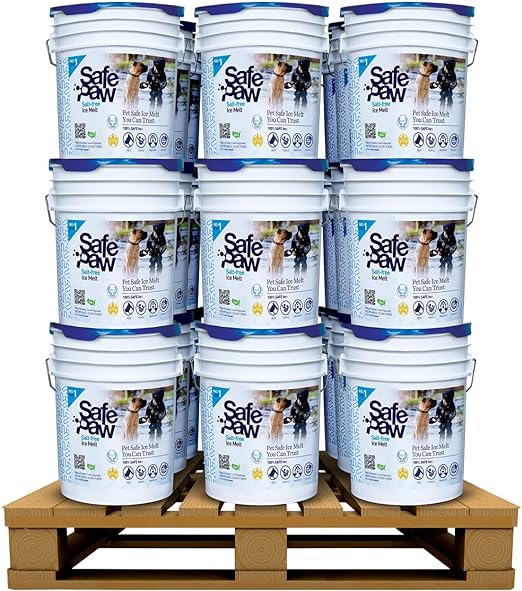
Safe Paw, Child Plant Dog Paw & Pet Safe Ice Melt -35lb, 36 Pails
6. Pickle Brine: A Salt-Containing Brine Alternative
Pickle brine contains dissolved salt and other food-production compounds. Because the salt component contributes to freezing-point depression, pickle brine should not be described as salt-free or chloride-free. Its exact performance depends on salt concentration and composition.
It belongs under salt-containing alternatives, not pet-safe no-salt methods.
How it works / Recipe
Pickle brine is salty water from pickle production; it contains salt plus some acidic content. Can lower the freezing and help a bit.
DIY recipe: Use leftover pickle brine, spray or pour over ice.
Effect depends on concentration; not effective alone in colder temps.
7. Sand, Ash and Coffee Grounds for Winter Traction
Sand and similar granular materials primarily improve traction. They do not lower water’s freezing point and should not be described as chemical ice melts.
For sand, this is strongly supported by EPA and ASPCA. (US EPA)
DIY recipe: Dust sand, ash, or coffee grounds over icy surfaces after shoveling.
Warnings / Limitations
Clean up required; may clog drains or make surfaces messy.
No melting means ice remains; these are only for traction or helping melt when temps rise.
7 Homemade Ice Melt Alternatives: Pros, Cons and Limitations
DIY Option
Primary Effect
Advantage
Main Limitation
Rubbing alcohol/water
Can depress freezing point
Useful on limited small icy areas
Flammable; pet ingestion hazard; performance concentration-dependent
Vinegar/water
Limited freezing-point effect
Inexpensive and accessible
Weak deicing performance; acidic
Fertilizer
Some ingredients can depress freezing point
Materials may be readily available
Nutrient runoff and pet exposure; not recommended as routine deicer
Beet + salt brine
Chemical deicing
May improve brine adhesion/reduce salt loss
Still contains salt/chloride
Sugar solution
Limited freezing-point depression
Accessible household ingredient
Sticky, inefficient and impractical at scale
Pickle brine
Chemical deicing from dissolved salts
Potential reuse of waste brine
Still salt-based; variable concentration
Sand/ash/grit
Traction
Immediate slip reduction
Does not chemically melt ice
Important Limitations of Homemade Ice Melt Recipes
A household ingredient is not automatically a tested pavement deicer. Performance depends on concentration, pavement temperature, ice thickness, moisture, application quantity, and the material being treated.
Do not describe a DIY material as “pet safe” solely because it is commonly found in a home or kitchen. Isopropyl alcohol, fertilizer, salt, and other household substances can cause problems if pets ingest sufficient quantities. (Pet Poison Helpline)
Do not mix household chemicals unless their compatibility is known. Homemade chemical combinations can create exposure hazards unrelated to ice melting.
Traction and melting are different goals. If preventing a slip is the immediate concern, traction may be more useful than trying to chemically melt thick ice.
Get ready for winter with – the ONLY Pet Safe Ice Melt you can trust
What Is the Safest Pet Safe Ice Melt for Driveways and Pets?
There you go! There’s a plethora of ice melting solutions options you can choose from. However, selecting the right ice melt for concrete and other surfaces is a challenge. It’s so because it involves balancing effectiveness with environmental and pet safety. Effective ice melt solutions should not only melt ice efficiently but also minimize harm to pets and the environment. That’s why products like Safe Paw are formulated to be effective even at low temperatures, unlike many DIY solutions that may fail in extreme cold. It’s not only a popular ice melt for sidewalk, driveway and concrete but is also safe to use around pets and kids.
Homemade Ice Melt Ingredients: Pet, Concrete and Environmental Considerations
DIY Material
Pet Consideration
Surface / Environmental Consideration
Isopropyl alcohol
Ingestion can cause poisoning
Flammable; material compatibility varies
Vinegar
Acidic; ingestion/contact may irritate
Repeated acidic exposure may affect some surfaces/soil
Fertilizer
Ingredient-dependent ingestion risk
Nitrogen/ammonia runoff concern
Beet + salt brine
Salt exposure remains relevant
Chloride runoff remains possible
Sugar solution
Avoid intentional ingestion
Sticky residue and pests
Pickle brine
Sodium/chloride exposure
Chloride residue and runoff
Sand / grit
Lower chemical-exposure concern when clean
Sediment and cleanup issues
ASPCA recommends caution with all chemical deicers and notes that paw residues can later be ingested during grooming. (ASPCA)
Which DIY Winter Method Fits Different Needs?
For immediate traction: use sand, grit, Ice Traction, or Walk On Ice.
For thin isolated ice patches: mechanical removal is preferable where practical; a tested deicing treatment can then address residual bonded ice.
For reducing rock-salt use: shovel first, apply less deicer, and avoid over-application.
For pet-used areas: avoid assuming household alcohol, fertilizer, salt brine, or pickle brine is inherently pet-safe.
For new concrete: use traction and mechanical removal rather than experimenting with chemical DIY recipes.
For environmentally sensitive drainage areas: avoid fertilizer and unnecessary chloride application.
This is more useful than ranking the seven recipes from “best” to “worst.”
Winter Driveway Tips Using Pet Safe Ice Melt
Maintaining your driveway in winter doesn’t just involve deicing. Deicing is just a small part of winter maintenance tips and pieces of advice we always recommend our readers to follow. Implement these winter driveway tips to prevent ice buildup:
Regularly clear snow before it compacts and turns into ice.
Apply ice melt in anticipation of freezing weather to prevent ice formation.
Check drainage systems to ensure melting snow and ice can drain away from your driveway, reducing re-freeze.
Homemade Ice Melt Performance: Evidence and Temperature Limitations
DIY Method
Temperature Evidence
Isopropyl alcohol mixture
Depends on alcohol/water concentration; do not use pure IPA freezing point as mixture performance
Vinegar mixture
No reliable universal residential working temperature established
Fertilizer
Performance depends heavily on chemical formulation; not recommended as routine DIY deicer
Beet brine
Depends primarily on the salt/brine formulation
Sugar solution
Concentration-dependent; generally weak/practical limitations
Pickle brine
Depends on salt concentration
Sand/ash
No chemical melting temperature; traction only
Ice and Snow Everywhere? Stock Up on Safe Paw – the ONLY Pet Safe Ice Melt you can trust
Why You Need a Homemade Pet Safe Ice Melt for Dogs and Paws
For households with pets, choosing a pet safe ice melt is essential to keep your furry friends safe during winter walks. Many commercial ice melts contain chemicals that can be harmful to pets if ingested or contacted. In fact, many homemade solutions might impact your pet’s health. In contrast, Safe Paw is a non-toxic, pet-friendly option that ensures the safety of your pets without sacrificing performance.
Pro Tip from Experts at Safe Paw“Always pre-treat your driveway before a storm. This prevents ice from bonding to the surface, reducing the total amount of ice melt you’ll need later. It’s safer, faster, and more cost-effective.”
Is Homemade Pet Safe Ice Melt Safe for Concrete? What to Know
As temperatures start to drop, the instinct is to search for “ice melt near me” and grab whatever is most accessible. But convenience shouldn’t come at the cost of your property—or your safety. Many commercial ice melt products, even those widely stocked in local stores, are made with harsh chemicals like calcium magnesium acetate or traditional salt blends that can damage concrete, corrode metal, and burn your pet’s paws. And just because something is available locally doesn’t mean it’s safe.
The EPA notes that CMA is less corrosive than salt but only effective down to about 20°F (EPA Fact Sheet).
Before purchasing from your go-to retailer, pause and consider your surface type, weather conditions, and environmental impact. For instance, calcium magnesium acetate is often marketed as a safer alternative to rock salt. While it’s less corrosive, it still requires heavy application to be effective, and it only works down to about 20°F—far above the sub-zero range that Safe Paw can handle. Plus, overuse of CMA can alter soil chemistry and harm nearby vegetation, making it a less eco-friendly choice than it appears.
And if you’re asking, “what temperature does it snow?”—the answer varies, but snowfall typically begins when the air temperature is around 32°F or lower. However, ice can form even when snow doesn’t, which means you need an ice melt that starts working before the freeze hits, not just after. That’s where Safe Paw excels—it can be used as a pre-treatment and remains effective down to -2°F. It doesn’t just melt ice; it prevents it from bonding to your driveway or sidewalk in the first place.
Why Safe Paw Is the Most Trusted Pet Safe Ice Melt Over DIY Recipes
If you’re thinking about grabbing a bag of ice melt salt near me, consider the risks of traditional chloride-based options. Most common salts (sodium chloride, magnesium chloride, and calcium chloride) can degrade concrete, stain surfaces, and pose serious risks to pets and children. Many homeowners think these products are safe just because they’re widely sold—but “available” doesn’t equal “safe.”
Instead of using products that may work temporarily but create long-term problems, look for a formula like Safe Paw’s. It’s completely free from chlorides and salts, yet delivers better melting action with its unique crystalline amide core and glycol-enhanced surface tension breakers. It doesn’t just melt—it protects.
When choosing a solution, always check whether the product is marked as pet-safe, non-corrosive, and effective at low temperatures. These qualities are rarely found in generic ice melt salt near me products, but they’re exactly what Safe Paw is built for.
Safe Paw has been tested for over 30 years on thousands of driveways, sidewalks, and pet households. Unlike generic chloride products, Safe Paw was created by a chemical engineer specifically to prevent pet paw burns and concrete damage.
From icy sidewalks to delicate concrete steps and driveways, Safe Paw offers a non-toxic alternative that gets the job done—without environmental backlash or health hazards.
Get ready for winter with the ONLY Pet Safe Ice Melt you can trust
Gaia Enterprises Inc. delivers 100% pet-safe and environmentally friendly winter products. Safe Paw, our flagship product, is the #1 selling pet-safe ice melt that does not harm pets, safe if ingested, and safe on all types of concrete.
Conclusion: Choosing the Right Pet Safe Ice Melt for Winter Safety
While homemade options and local store shelves might seem like the fastest route during a surprise freeze, blindly picking an “ice melt near me” can lead to property damage, pet harm, and ineffective results in colder conditions. Understanding how products like calcium magnesium acetate work—and their limitations—can help you make more informed decisions. Likewise, knowing what temperature does it snow gives you a strategic edge in applying ice melt before problems arise.
Snowfall usually begins at 32°F or below, but the National Weather Service explains that snow can still occur when ground temps are slightly above freezing (NOAA).
Most DIY options only work above 20°F or provide temporary traction. Safe Paw is different—it works down to –2°F, prevents bonding, and is the only ice melt trusted for 30 years of pet and child safety.
Safe Paw takes the guesswork out of winter prep. It’s safe, reliable, and effective even in sub-zero weather, outperforming standard ice melt salt near me picks in every way. This winter, be proactive—not reactive.
Get ready for winter with the Only Pet Safe Ice Melt you can trust!
Pet Safe Ice Melt FAQs: Homemade Solutions, Pets, and Concrete
There is no single DIY option that combines strong deicing performance, pet safety, surface compatibility, and environmental neutrality. Salt-based brines offer predictable melting but retain chloride-related drawbacks. Sand and grit provide traction without melting the ice. Other household mixtures generally have more limited or less predictable performance.
An isopropyl-alcohol/water solution can lower freezing temperature, but performance depends on the alcohol concentration. Do not use -20°F as a universal figure based on the current CDC citation; CDC lists pure isopropanol at about -127°F. (CDC)
It should not be described as automatically pet-safe. Ingestion of isopropyl alcohol can cause poisoning in pets. (Pet Poison Helpline)
Not necessarily. Beet-derived winter treatments are commonly mixed with salt or brine. A formulation containing sodium chloride is not salt-free or chloride-free. (US EPA)
No. Pickle brine already contains dissolved salt. Its deicing effect depends partly on that salt content.
No. Sand primarily improves traction. It does not lower the freezing point of water. (Poison Control)
It is not recommended as a routine household deicer. Urea-containing fertilizers can contribute nitrogen and ammonia to runoff, and fertilizers may also create pet-exposure concerns. (US EPA)
Do not assume a DIY solution is appropriate for new concrete. Safe Paw’s current first-party guidance recommends avoiding any ice melt on concrete less than 12 months old and using traction instead during the curing period. (Safe Paw Ice Melter)
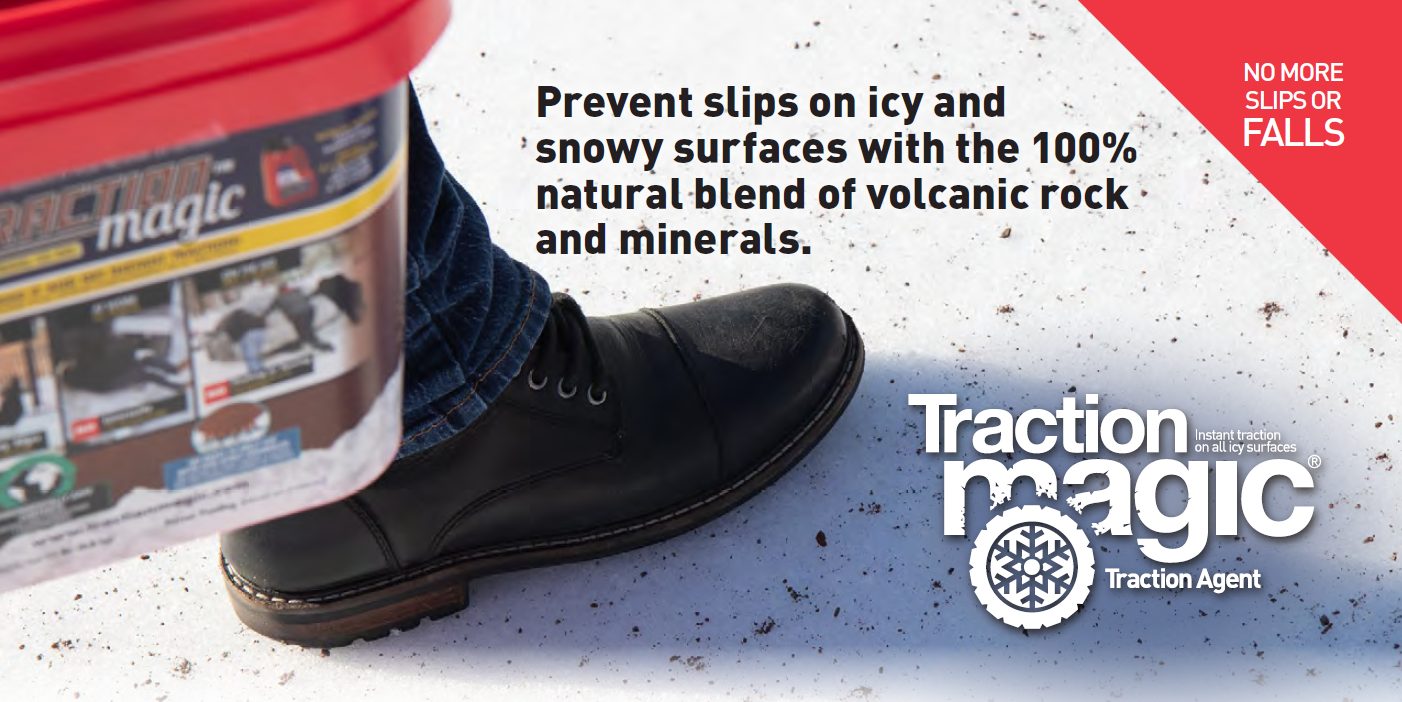
Stay safe on slippery surfaces with a product that’s 100% natural and safe for pets, people, and your property. Use Traction Magic on sidewalks, steps, or as instant traction for your car.
Imagine an ice melt you can put down and never worry about. It won’t harm pets, kids and your property. That’s Safe Thaw. Unlike anything else on the market, Safe Thaw can change how winter affects our planet.
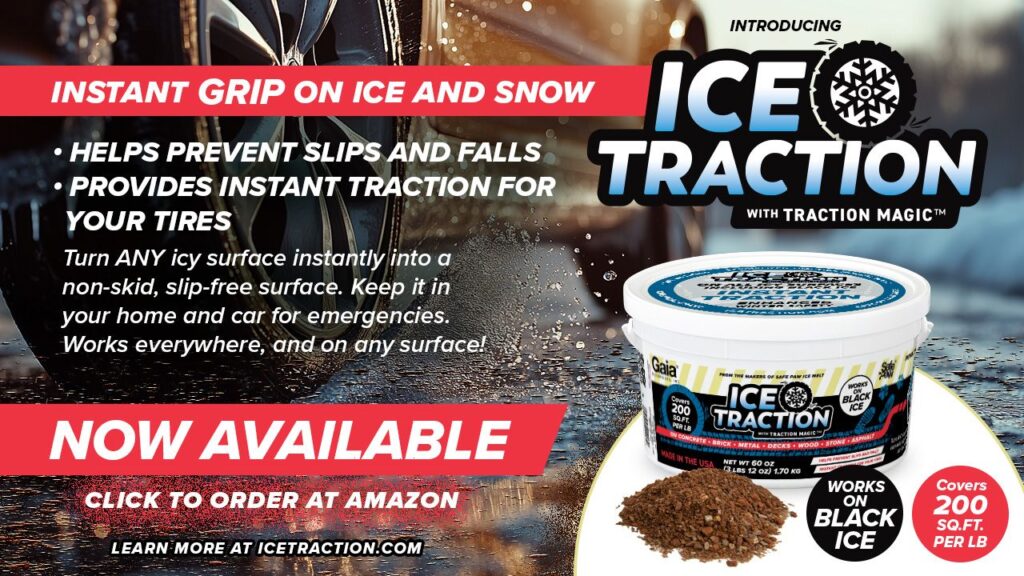
Ice Traction (with Traction Magic™) is your go-to winter solution for driveways, walkways, parking lots — and even black ice on the road. Unlike salt or ice melts, it delivers instant grip on snow and slippery surfaces with no wait time. Just spread and go.
Imagine an ice melt you can put down and never worry about. It won’t harm pets, kids and your property. That’s Safe Thaw. Unlike anything else on the market, Safe Thaw can change how winter affects our planet.
Shweta, a passionate pet lover and environmental advocate, has dedicated herself to promoting winter safety for pets. Living amidst the scenic, snowy landscapes of Canada, she expertly merges her love for animals with her exceptional writing talents. Her commitment is deeply rooted in ensuring the well-being of pets during the harsh winter months.